
When an all-electric Tesla Model S burns out after an accident in 2013, the manufacturer's share price collapses. Tesla loses three billion US dollars on the stock market - at the time that is twelve percent of the company's value. No one is injured. Serious damage is only caused economically.
Electric cars do not transport flammable liquid in tanks under the rear seat. But they have a large amount of electrical energy on board. Customers should be aware that they can burn. Also because Samsung stopped the Galaxy Note 7 smartphone in 2016 after the battery in several devices burned and passengers were no longer allowed to take them on the plane. Sony bought back ten million laptop batteries in 2006 because of the risk of fire. Boeing paused the operation of the Dreamliner after a battery caught fire.
Burning batteries are tricky. Especially when many of them are connected to each other – as in electric cars. Dealing with and effects of this are still unfamiliar to all those involved. The problem: electric cars burn differently than other vehicles. A chain reaction of short circuits can occur in the battery. After the fire is extinguished, it can flare up again elsewhere. The fire in one battery cell creates one fire in the next.
Experts speak of the so-called "thermal runaway". In addition, there are the different causes of burning electric cars:
- Severe damage to the battery due to an accident or foreign object
- Severe overheating of the battery
- Invisible defects in battery cells where the electrodes touch each other
No major fire risk with an electric car
So are electric cars more dangerous than combustion engines? First of all, they do not burn more often. This was confirmed by the German Insurance Association (GDV) at the request of mobile.de: "In our opinion, electric cars do not pose a higher fire risk than vehicles with combustion engines." Karl-Heinz Knorr, Vice President of the German Fire Brigade Association, told the German Press Agency: "E-cars are burning (...) neither more violently nor more frequently than gasoline or diesel, just differently." The ADAC speaks of a comparatively low risk.
GDV and the fire brigade do not keep statistics on the ratio of the drive types of burning cars. However, because electric cars are new to the market, fires are reported more intensively. To put this into perspective: In 2017, insurers in Germany regulated a total of 13,115 vehicle fires. This corresponds to 36 burning vehicles per day. In relation to the entire vehicle fleet, an electric car or a plug-in hybrid would have to burn every nine days due to a defect in the battery for the statistical tie.
Measures to protect the batteries
The manufacturers of electric cars are aware of the uncertainty of customers. In the worst case, this results in a negative image of the drive form. That is why car manufacturers protect the batteries of their vehicles with the following measures:
- Automatic circuits disconnect the power supply when an airbag deploys in the car.
- Software monitors charging and discharging processes to prevent overheating.
- Battery packs are particularly stable and part of the car's load-bearing structure.
- Special materials protect batteries from foreign body impacts.
Many electric cars achieve the highest ratings in all disciplines in the official Euro NCAP crash tests. No damage to the battery housings was found. The components even contribute to the stability of the rest of the body. The battery packs are protected at the front and rear by the crumple zones.
According to the ADAC, a side impact that deforms the battery could be critical. There is a much smaller area that collects the energy. In the crash test, this situation is simulated by an impact with a battering ram (50 km/h) and a pole (34 km/h). So far, no electric car has attracted negative attention, says the club. However, the ADAC points out that this does not provide any indication of more violent impacts.
Burning electric car: More water to extinguish
What to do if an electric car burns despite all the measures? An expert from the fire brigade explains to mobile.de: "We get the fire out, but it's more complex." Specifically, you need much more water to cool the battery over a long period of time. This prevents thermal runaway.
There is no danger of an electric shock when extinguishing, because the water jet of the spray pipes used by the fire brigade consists of many droplets that do not conduct the current to the rescuer. The rescue workers do not wear special protective equipment. Dangerous fumes caused by burning plastics can be found in all vehicle categories. The electric car is not unusual here.
In cities, the water problem is easy to solve thanks to the available hydrants. On motorways, you have to prepare for this with an additional emergency vehicle or search the area for a water source in advance. The emergency call should therefore be informed if an electric car is involved in the accident.
Tesla states that around 11,000 liters of water are needed to extinguish a burning Model S. Normal emergency vehicles store about 2,000 liters of water, usually enough for burning vehicles with combustion engines. There are also additives or extinguishing foam for them, which has been specially developed for such fires.
The fire brigade is working on better solutions
The development of special means against burning electric cars is already underway. Currently, the vehicles can be stored in a large tub filled with water to prevent further ignition. This simplifies battery cooling, but only works for cars, not for trucks or buses. In the future, a so-called nail could introduce the extinguishing water directly into the battery. Extinguishing additives could cool the battery better.
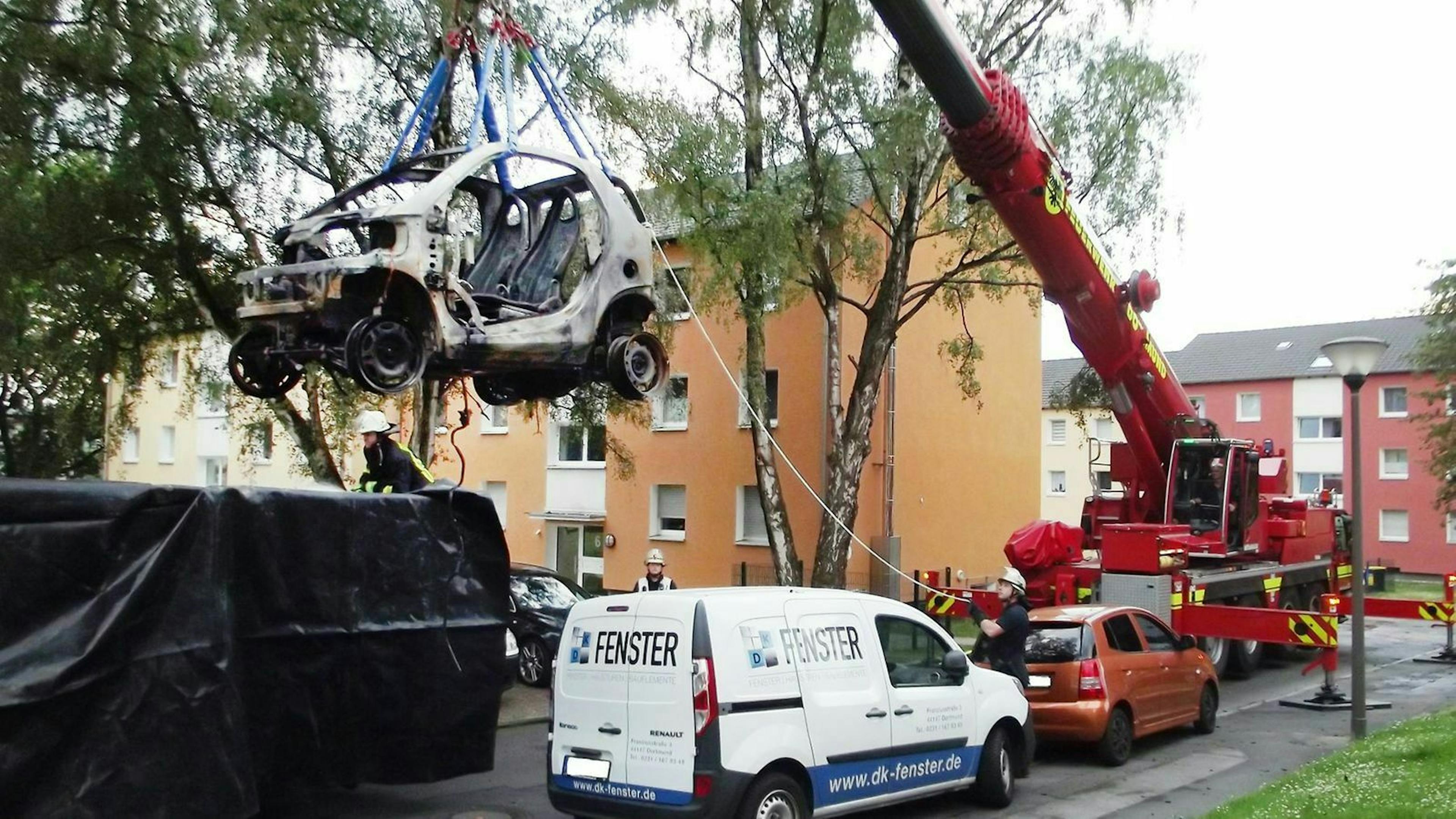
Until new funds are available, the German Fire Brigade Association recommends the following procedure in its "Risk Assessment Lithium-Ion Storage Media": "The fire brigade carries out effective extinguishing measures with water and prevents further spread of fire and smoke to other fire compartments. In the further course, the heat development of the lithium-ion storage medium should be monitored, e.g. by means of a thermal imaging camera."
However, it is difficult to determine whether the fire has actually been extinguished: "There are no indicators from which a re-ignition can be ruled out with sufficient certainty. For this reason, lithium-ion storage media should be moved to a safe location or handed over to a disposal company."
In the event of an electric car fire, there is therefore more for the fire brigade to do. The extinguishing process and disposal mean more effort. Depending on the location of the fire and the infrastructure on site, the emergency services must be specially organized. But solutions to these problems are in development. The electric car itself poses no major danger.
What to consider when an electric car fires
With an electric car, you don't have to limit yourself. You can drive, park and charge anywhere, even in narrow underground garages: "From today's perspective, certified charging facilities in garages can also be accepted in underground garages as necessary components of the operation and parking of vehicles," the risk assessment says.
If an electric car catches fire, the same applies to the passengers as to the fire of a vehicle with a combustion engine. They should:
- Leave the car as soon as possible
- Report the fire and indicate that it is an electric car
- Stay away from the burning car: Airbags, shock absorbers and tires pose a danger
- Do not approach the extinguished vehicle until it is cleared by the fire department
The rescue workers must:
- Provide a larger amount of extinguishing water
- Monitor the temperature of the battery after extinguishing it
- Organize a special removal that takes into account that the battery can catch fire again
- Store the vehicle in quarantine so as not to endanger other vehicles in the event of a new ignition
Post a Comment for "What to do when an electric car is on fire"